Disclosure: We may earn a commission from Amazon links on this page. This helps support our independent testing.
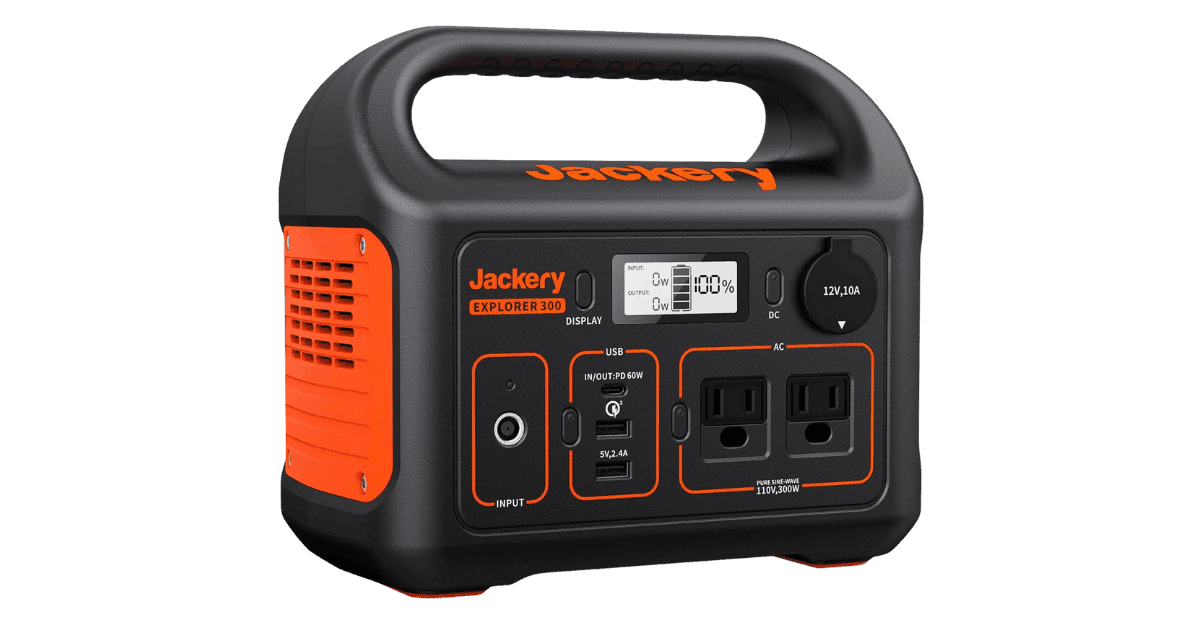
Ultra-portable entry-level power station for basic needs.
WattsGeek Rating
"Recommended"
The Jackery Explorer 300 is a decent choice if weight is your absolute priority or if you find it on a deep discount (<$180). However, most users should opt for the newer Jackery Explorer 300 Plus or EcoFlow RIVER 2 for better battery longevity.
The Jackery Explorer 300 has been a staple in the camping world for years, often serving as the entry point for users discovering portable power. Unlike the newer \"Plus\" or \"v2\" models flooding the market, this classic unit relies on older Lithium-ion (NMC) battery technology. Why buy it in 2024? Simple: Weight. At just 7.1 lbs, it remains one of the lightest 300Wh power stations ever made, lighter even than its own successor. It’s a no-nonsense, grab-and-go power source for casual users who value simplicity over cutting-edge specs.
The design is classic Jackery: rugged orange and gray plastic with a sturdy fixed handle. It feels solid and durable. Because it uses NMC battery cells (the same kind found in many electric cars), it is denser and lighter than modern LiFePO4 units. Its compact 9.1 x 5.2 x 7.8-inch footprint means it tucks easily behind a car seat or into a large backpack.
With 293Wh of capacity and a 300W inverter (500W surge), this unit is designed for personal electronics and small appliances.
It will not power hair dryers, blenders, or heaters. If you exceed 300W, the unit will shut off to protect itself.
This is where the unit shows its age.
Wall Charging: Takes about 4.5 hours with the included brick. (Pro tip: Plug in a USB-C charger at the same time to drop this to 2 hours).
Solar Charging: Accepts up to 90W input. With a SolarSaga 100W panel in good sun, expect a recharge in about 5 to 6 hours.
Car Charging: Takes roughly 5 hours via the 12V cigarette lighter port.
This unit is ideal for casual campers who only go out a few times a year and want the lightest possible battery to carry to the picnic table. It's also a great budget buy if you can find it used or heavily discounted, serving as a dedicated charging station for phones and tablets during road trips.
If you plan to use your power station every weekend or for daily off-grid living, do not buy this model. The 500-cycle battery life means it will degrade faster than modern LiFePO4 units (which last 3,000+ cycles). You should look at the Jackery Explorer 300 Plus or EcoFlow RIVER 2 instead.
Vs. Jackery Explorer 300 Plus: The \"Plus\" is the modern replacement. It has a LiFePO4 battery (10-year life), app control, and faster charging, but it weighs more (8.27 lbs vs 7.1 lbs).
Vs. EcoFlow RIVER 2: The RIVER 2 charges fully in just 60 minutes (vs 4.5 hours for the Jackery) and has a longer-lasting battery, making it a better value at full retail price.
The Jackery Explorer 300 is an aging warrior. While it lacks the fast charging and longevity of modern rivals, its lightweight chassis and simple operation keep it relevant for casual users. If portability is your #1 concern, it's still a contender. But for longevity and value, newer models have left it behind. We rate it a 7.4/10.
| Feature | Laboratory Data |
|---|---|
| Total Capacity | 293 Wh |
| Continuous AC Output | 300 W (500W Surge) |
| Battery Chemistry | Li-ion |
| Cycle Life (80%+) | 500 Cycles |
| Charge Time (AC) | 2 hours |
| Dimensions | 9.1 x 5.2 x 7.8 in |
| Net Weight | 7.1 lbs |
Approximate price. Actual prices may vary by retailer and change over time. Amazon prices fluctuate frequently and may differ from what is shown.